
When Your Renewal Notice Shows the Same Full Coverage You Carried When Financing
You paid off your 2016 Camry eighteen months ago. You're driving 3,500 miles a year now that the office commute is gone. Your renewal notice arrived last week showing the same collision and comprehensive premiums you paid when the bank required them—around $600 annually for both, stacked on top of your liability coverage. You kept renewing it because the agent said full coverage was the safe choice, but you're paying $1,200 a year total on a car worth perhaps $9,000 in today's market, and you're wondering whether that ratio still makes sense.
This article clarifies when collision and comprehensive coverage on a paid-off vehicle earns its cost for a retiree driving low annual mileage in Dayton, and when switching to liability-only with a cash reserve serves you better. Ohio law requires liability minimums but leaves the collision and comprehensive decision entirely to you. Most renewal notices don't frame it as a line-item judgment call; they present full coverage as the package. That framing costs you clarity.
Compare rates from carriers that specialize in senior drivers
Mature driver discounts, low-mileage rates, and coverage reviews — see what you're actually eligible for.
Get Your Free QuoteOhio Bodily Injury Minimum Per Person
$25,000
Ohio requires $25,000 per person, $50,000 per accident bodily injury liability, and $25,000 property damage. Collision and comprehensive are optional once your lien is satisfied. Those minimums are the floor you cannot drop below; everything above them is your choice.
Ohio Revised Code §4509.51
What Full Coverage Actually Covers on a Paid-Off Car
Full coverage is not a single product. It's the pairing of collision coverage (pays for damage to your car when you hit something or roll it, minus your deductible) and comprehensive coverage (pays for theft, vandalism, hail, fire, animal strikes, and glass damage, minus your deductible) on top of your liability coverage. When you financed the Camry, the lender required both because the car secured the loan. Once you paid it off, that requirement disappeared. The coverage stayed on your policy unless you called to remove it.
Collision and comprehensive protect your car's current replacement value, not what you paid for it. A 2016 Camry in good condition with typical mileage trades around $8,000 to $10,000 in the Dayton market as of current valuations. If you total it, your carrier pays that amount minus your deductible—typically $500 or $1,000. If your annual collision and comprehensive premium runs $600 and your deductible is $1,000, you're paying $600 each year to protect the $7,000 to $9,000 net exposure after the deductible. That ratio works when the car is new or when you cannot absorb a $9,000 loss without financial hardship. It stops working when the premium-to-net-exposure ratio crosses roughly 10 percent annually and you have liquid savings that could replace the car outright.
Ohio's fault system is traditional tort: the at-fault driver's liability coverage pays for your car's damage when they cause the accident. Your collision coverage is the fallback when the other driver is uninsured, underinsured, or flees the scene. Comprehensive covers non-collision losses your emergency fund would otherwise absorb. Both are valuable when the car's value justifies the annual cost. Neither is required by Ohio law once your lien is satisfied.
You're comparing the annual collision and comprehensive cost against the net check you'd receive after your deductible, not the car's full value. That net figure is what the coverage actually protects.
The Coverage-Fit Calculation for a Paid-Off Sedan
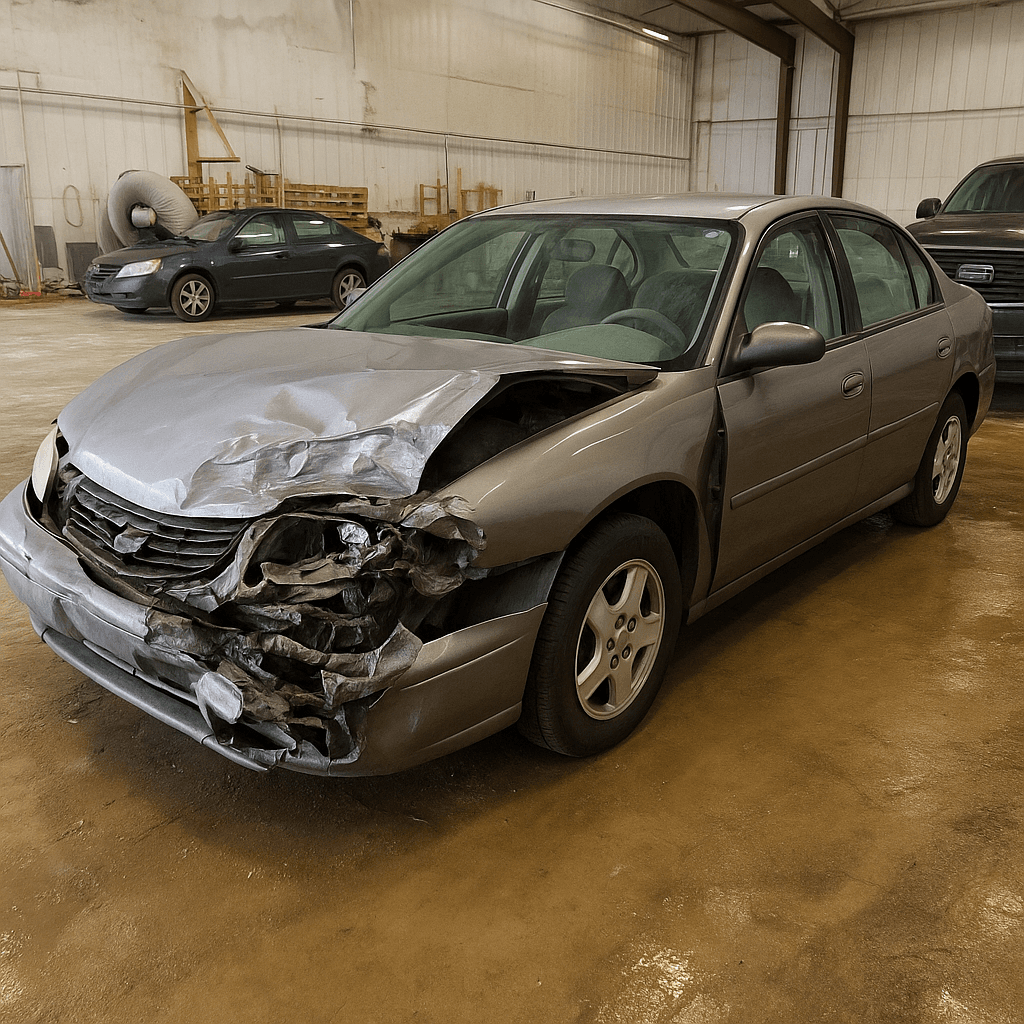
Start with your car's current market value. Check local private-party listings for your make, model, year, and mileage on sites like Kelley Blue Book or Edmunds. Subtract your collision deductible (the amount printed on your declarations page, typically $500 or $1,000). That net figure is what your collision coverage actually protects. If your Camry is worth $9,000 and your deductible is $1,000, the net exposure is $8,000. Now look at your annual collision premium. If it's $400 and the net exposure is $8,000, you're paying 5 percent of the protected value each year. That's a reasonable ratio for many retirees. If the premium is $600 and the car's value has depreciated to $7,000 net, you're paying 8.5 percent annually. At 10 percent or higher, most retirees with liquid savings find liability-only plus a dedicated cash reserve more efficient.
Comprehensive coverage follows the same math but protects against different risks: theft, hail, vandalism, deer strikes. Dayton sits in a moderate auto-theft zone compared to Columbus or Cleveland; comprehensive claims are less frequent here than in urban cores, but hail and deer remain real risks in Montgomery County. If your comprehensive premium runs $200 annually and the car is worth $9,000, that's 2.2 percent of the value each year. Comprehensive is cheaper than collision because the risks it covers are statistically rarer. Many retirees who drop collision keep comprehensive for another year or two, then drop both once the car's value falls below $6,000.
Related Articles




How Low Mileage and a Clean Record Change the Collision Risk Equation
You're driving 3,500 miles a year in retirement. That's roughly 30 percent of the national average and a fraction of the 12,000 to 15,000 miles you logged annually during your working years. Lower mileage reduces your collision exposure mechanically: fewer miles means fewer intersections, fewer highway merges, fewer hours in traffic, and statistically fewer opportunities for an at-fault accident. Your collision premium does not automatically drop when your mileage does unless you tell your carrier and they adjust the rating factor. Many retirees pay commuter-era collision premiums for years after the commute ends because the renewal notice never asks how many miles you drove last year.
If you haven't reported your mileage reduction yet, call your agent or log into your carrier's portal and update it now. Geico, Progressive, Nationwide, and State Farm all write in Ohio and offer mileage-based rating adjustments. Expect a 10 to 20 percent reduction in your collision premium when you drop from 12,000 annual miles to 4,000, assuming your carrier applies the adjustment. Some carriers require odometer verification via photo upload; others adjust on self-report and audit later. The reduction applies whether you keep collision or drop it, but it sharpens the coverage-fit calculation: a $400 collision premium that drops to $320 after a mileage adjustment changes the annual cost-to-value ratio meaningfully.
Your decades-long clean record also matters here. Ohio insurers are required by statute to offer a mature-driver discount for operators 60 and older who complete a state-approved accident prevention course. Ohio Revised Code §3937.43 mandates the discount but leaves the percentage to each carrier's filed rating plan. The discount applies to your liability premium primarily, but some carriers extend it to collision and comprehensive as well. If you haven't completed the course yet, completing it may reduce your total premium by enough to keep collision coverage economically sensible for another year. If you've already completed it and the discount is applied, factor that into your current premium when running the coverage-fit math.
Carriers Writing Auto in Ohio
25
Twenty-five carriers write personal auto insurance in Ohio, including Geico, State Farm, Progressive, Nationwide, and Erie. Each prices collision and comprehensive differently for retirees with low mileage and paid-off cars. Comparing three quotes shows you what dropping collision saves and whether another carrier prices liability-only more competitively than your current one.
NAIC carrier licensing data, Ohio Department of Insurance
When Liability-Only Plus a Cash Reserve Serves You Better
If your collision and comprehensive premiums total $600 annually and your car is worth $8,000 after the deductible, you'll pay $6,000 over ten years to protect an asset that will depreciate to near-zero by year ten. The alternative: drop both coverages, bank the $600 annually in a dedicated vehicle-replacement account, and self-insure the risk. After five years, you'll have $3,000 saved—enough to replace a significant fraction of the car's value if you total it. After eight years, you'll have $4,800 saved and the car's market value will have fallen to perhaps $4,000. At that point, the cash reserve matches or exceeds the car's value, and you've effectively self-insured the collision risk at a lower cumulative cost than paying the carrier.
This path works when you have the liquidity to start the reserve and the discipline to leave it untouched. It does not work if a $7,000 loss today would force you to finance a replacement or go without a car while rebuilding savings. The coverage-fit question is not whether collision coverage is worth having in the abstract; it's whether paying $600 a year to transfer a $7,000 risk to the carrier serves you better than keeping $600 a year and accepting the risk yourself. For many Dayton retirees with paid-off cars, modest savings, and mileage under 5,000 annually, the self-insurance path becomes the better trade once the car passes eight years old or falls below $8,000 in value.
What Stays on Your Policy When You Drop Collision
Dropping collision and comprehensive does not reduce your liability coverage. Ohio's $25,000 per person, $50,000 per accident bodily injury liability minimum and $25,000 property damage minimum remain in place, and most retirees carry higher limits—$100,000/$300,000/$100,000 or $250,000/$500,000/$100,000—to protect retirement assets from an at-fault accident judgment. Those liability limits stay unchanged when you remove the collision and comprehensive line items. Your premium drops by the collision and comprehensive cost only; liability, uninsured motorist, and any medical payments coverage you carry remain at their current levels and premiums.
If you carry uninsured motorist coverage—and you should, given that roughly 13 percent of Ohio drivers are uninsured—that coverage continues to protect you when an uninsured driver causes an accident and flees or has no assets to pursue. Uninsured motorist property damage coverage pays for your car's damage when the at-fault driver has no insurance; it functions as a collision-coverage substitute in that scenario, though it requires proving the other driver was at-fault and uninsured. Collision coverage pays your claim immediately regardless of fault; uninsured motorist property damage requires the fault investigation first. The trade is claims simplicity for lower annual cost. Many retirees accept that trade once the car's value falls below the threshold where paying collision premiums no longer makes economic sense.
Compare What You're Paying Now Against What Three Ohio Carriers Would Charge for Liability-Only
You've run the math and decided liability-only plus a cash reserve fits your situation better. Before you call your current carrier to drop collision, get quotes from at least two other Ohio carriers for the same liability limits you carry now, with collision and comprehensive removed. Geico, Erie, Nationwide, State Farm, and Progressive all write in Dayton and offer online quoting tools that process liability-only quotes in under ten minutes. You may find that your current carrier prices liability-only at $420 annually while Erie or Geico prices the identical coverage at $310. The difference pays for a year of the vehicle-replacement reserve outright.
When comparing, hold your liability limits constant. If you carry $100,000/$300,000/$100,000 now, quote the same limits at every carrier. Dropping collision is a coverage decision; switching carriers is a price decision. Don't conflate them. Once you've compared three quotes and identified the lowest-cost option for your liability limits, mileage, and mature-driver discount status, make the switch if the savings justify it or stay with your current carrier and remove the collision and comprehensive line items. Either way, you've made the decision with full information rather than inertia.